PART 2: ENERGY, MARKET AND EMPLOYMENT
In Vietnam, the fuel price have been adjusted to the market and the fuel can be accessed anywhere at almost identical prices. Vietnam's refining capacity does not meet the domestic demand, so the price of petroleum products is in line with world market price fluctuations. The price stabilization fund for petroleum products is established to regulate the impact of global market price fluctuations on domestic consumers, however, the fund proved to be ineffective.
Electricity prices are tight and relatively cheap, at an average of 7.6 Cent/kWh by 2015. This is the latest price increase, while in two years (from 2015 to mid-2017) the inflation rate is over 5%. In addition, there is a cumulative debt in the state-owned energy companies, and these businesses pay only a very small profit to the state.
The energy market is dominated by SOEs such as EVN, TKV, PVN and Petrolimex. EVN controls 2/3 of Vietnam's total power generating capacity, while TKV and PVN controls nearly the remaining one-third.
Vietnam has embarked on a reform of the electricity sector under the Electricity Law 2004, aimed at "increasing energy efficiency in electricity operations." This process has created competition in the electricity wholesale market, however, five electricity companies under the EVN (distribution companies) are still the "sole buyers"; and a competitive electricity retail market is only expected to be completed by 2024.
EVN has a high debt ratio, while some of its projects are funded by Official Development Assistance (ODA) and guaranteed by the Government. In addition, EVN is operating at a loss in 2015 - the last year the data is available. The World Bank's analysis shows that EVN has a strong demand for investment, but it must improve its performance, develop its financial strategy for debt and raise its electricity price by 15% inflation rate.
Vietnam ensures that electricity price in remote areas are equal to that of other regions, although investment in infrastructure per electricity customer is much higher. Although following a dramatic increase in non-hydro renewable energy sources (including stopping fossil fuel subsidies, establishing costs, or carbon taxes and increasing energy efficiency), or under business as usual (BAU), with its current policy of favorably importing coal and gas at large scale, is expected to increase electricity price.
The transition to high energy efficiency and renewable energy is expected to contribute to GDP growth over conventional development scenarios. But both scenarios may have adverse effects on low-income households and certain businesses.
Power-hungry small and medium enterprises are vulnerable to rising energy costs. However, studies show that many businesses can cope well if prices are rising slowly, on schedule and at a limited level. Businesses can save energy through negligible changes in management, production, or distribution.
In addition, the stable power supply is the first concern of most enterprises instead of the price. However, energy-related business supporting programs and projects remain limited, and commercial banks are almost uninterested in supporting loans for energy efficiency projects. Large FDI enterprises and large domestic firms agree with this view, and will pay more attention to rooftop solar power to reduce electricity bills if electricity prices rise slightly.
Coal mining creates jobs for about 140,000 workers by 2015 and the power sector create about 120,000 jobs, but there are no clear figures for renewable energy equipment production. However, a model study shows that, according to the BAU scenario, fossil-fuel-based electricity sector generates 6.6 million job-years in the period of 2015-2050 while scenarios towards renewable energy exploitation and energy efficiency improvement will generate 8.6 million to 11.6 million job-years.
CPSI office




 MoU on sustainable development for textiles and footwear signed
 Vietnam - UK cooperate for sustainable development
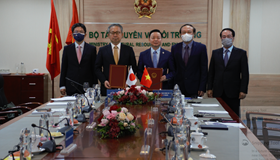 Vietnam, Japan sign a Memorandum of Understanding on low-carbon growth
 Increasing solutions in response to climate change
 Realizing vision towards sustainable green agriculture development
 WWF-Vietnam calls to reduce plastic waste
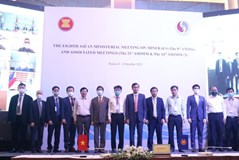
 Promoting ASEAN cooperation towards sustainable development of mineral exploitation
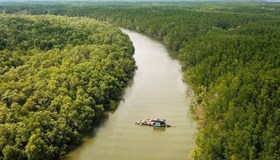 Developing forests in coastal areas in response to climate change