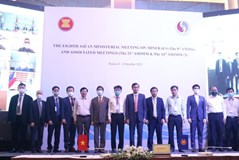
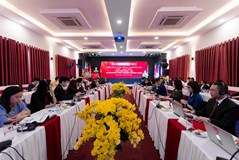
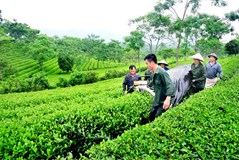
This event is under the framework of the Climate Fund Ready Program in Vietnam and supporting activities for the investment process in co-generation (CHP) projects using bagasse of sugar mills under the Energy Assistance Program implemented by the Ministry of Industry and Trade in coordination with GIZ. The workshop is a place for the parties to meet, discuss and exchange investment opportunities in energy cogeneration projects as well as to create opportunities for development of economic cooperation.
Accordingly, 05 pre-feasibility reports carried out at Phung Hiep Sugar Factory, Vi Thanh Sugar Joint Stock Company, Dak Lak Sugar Joint Stock Company, Lam Son Sugar Joint Stock Company and Nghe An Sugar Limited Company were presented at the workshop by the consultancy company of Germany - E-Quadrat, Enerteam, Institute of Energy and Power Engineering Consultant Joint Stock Company 4. However, for these projects to be implemented, businesses expect the Government to have a fair and equitable price policy.
According to Pham Ngoc Doanh, Chairman of Vietnam Sugar Association, "The energy price from bagasse (cogeneration) is regulated only at 5.8Cent/kWh while the price of biomass (energy from rice husk, biogas, etc.), the price is over 7Cent/kWh. In order to encourage investment in bagasse-based energy development, the government needs to adjust its pricing policy, and we expect bagasse-based energy price to equal biomass-based energy price".
"While the proportion of Vietnam's electricity output comes mainly from hydropower plants, in the dry season the electricity generation capacity of hydro power plants is low but this is the production time of sugar mills. so if we have a reasonable policy on electricity prices for bagasse-based energy projects, this will be an opportunity to develop the Vietnam biomass-based energy market, contributing to ensuring energy security of the country, "Doanh said.
Currently, Vietnam's sugar industry is building a restructuring project towards increasing productivity, quality and added value; Restructuring and diversifying products from sugarcane in the sugar industry. If there is a comprehensive solution to restructure effectively by 2030, the sugarcane production can produce 4.5 million tons of sugar; The electricityproduction from sugarcane could reach 4.7 million MWh, equivalent to a electricity generation capacity of 1600 MW and commercial electricity production to 50-60%, reaching over 2.8 million MWh, equivalent to the national grid capacity of 900 MW. This is a great potential for Vietnam to have more clean energy sources.
Sharing at the seminar, Sonia Lioret, Head of Renewable Energy and Energy Efficiency Project of the German Development Cooperation (GIZ) "Vietnam has made commitments to achieving renewable energy target outlined in the revised VII Power Development Plan. Accordingly, biomass energy will account for 1% by 2020 and 3% of total electricity production by 2030. And when talking about biomass, we are talking about bagasse in Vietnam."
At the workshop, experts talked about the development status of Vietnam's sugar industry and the world’s sugar industry, and the potential for bagasse-based energy production. Also in this workshop, the representatives of the Institute of Energy (Ministry of Industry and Trade) introduced the Handbook for developing biomass-based electricity project in Vietnam developed by GIZ in coordination with the General Department of Energy, Ministry of Industry and Trade.
CPSI office




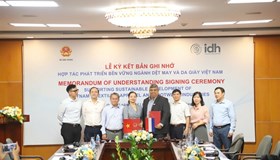 MoU on sustainable development for textiles and footwear signed
 Vietnam - UK cooperate for sustainable development
 Vietnam, Japan sign a Memorandum of Understanding on low-carbon growth
 Increasing solutions in response to climate change
 Realizing vision towards sustainable green agriculture development
 WWF-Vietnam calls to reduce plastic waste
 Promoting ASEAN cooperation towards sustainable development of mineral exploitation
 Developing forests in coastal areas in response to climate change