In Nam Binh Duong solid waste treatment complex's plant, the household waste is recycled into compost to fertilize crops in the locality and neighboring provinces. The compost plant has had a capacity of 420 tons of waste per day.
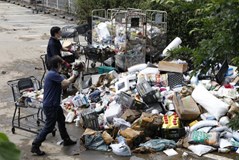
Every day about 1200-1500 tons of household waste, industrial waste from different parts of the province of Binh Duong to return the complex processing of solid wastes South Pacific. Household waste will be transported by the garbage trucks to the complex's landfills. Then, the garbage trucks will continue to move to the washing yard. The water, which uses for cleaning the from leachate treatment.
First, the waste must be sorted and cleaned in order to become suitable material for fertilizer production on an industrial scale. Household waste is moved into the automatic sorting line to remove inorganic components (metals, sand, stones,...) and persistent organic ingredients (plastic, rubber,...). In the process of classifying some rubbish being reused, while others are used as raw materials to produce concrete or adobe bricks. Some kind of fibers, Inorganic compounds, ect that can not be decompose will be taken to bury or burn. The organic ingredients that are easily to be biodegradable will be separated. Then, those ingredients are mixed with probiotics and added air to speed up the fermentation and decomposition.
After about 20 days, the garbage is ripe and we can move to the next step of making hummus. The ingredients which have not yet biodegradable will continue to be classified and separated from the mixture in order to ensure the consistency and quality of the compost. Then, the humus is added some organic materials, nutrients and the amount of minerals according every type of fertilizer and following the prescription of the Ministry of Agriculture and Rural Development.
During fermentation, the garbage is covered with HDPE tarpaulin and sprayed chemical on the surface for deodorant and speeding up the decomposition. The leachate is recovered simultaneously with the bags to run the generators using for operating the leachate treatment system and supplying power to the complex's mechanical workshop. The production process has become an almost closed cycle. That helps improving the energy conservation and efficiency, maximize the capacity utilization of resources and energy.
The compost "Binh Duong elephant" of Nam Binh Duong solid waste treatment complex was registered properly tested processes, meet the certified quality standards and the environmental standards. Its price is very competitive and be in line with the consumer needs. Currently, the compost which is produced by Nam Binh Duong solid waste treatment complex has been trusted by the domestic and international markets.
CPSI




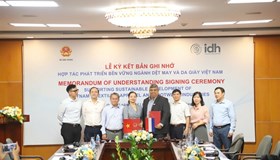 MoU on sustainable development for textiles and footwear signed
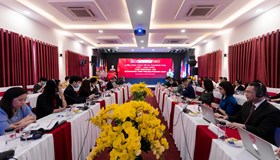 Vietnam - UK cooperate for sustainable development
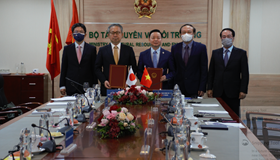 Vietnam, Japan sign a Memorandum of Understanding on low-carbon growth
 Increasing solutions in response to climate change
 Realizing vision towards sustainable green agriculture development
 WWF-Vietnam calls to reduce plastic waste
 Promoting ASEAN cooperation towards sustainable development of mineral exploitation
 Developing forests in coastal areas in response to climate change