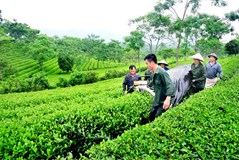
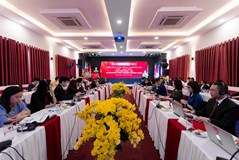
The WB Vietnam said together with the Mekong Delta Integrated Climate Resilience and Sustainable Livelihoods Project, the financing marks a new stage in the WB’s support for Vietnam when the country is focusing on inclusive green growth and eliminating risks in climate change response.
According to Achim Fock, Acting Country Director for the WB in Vietnam, fostering climate change adaptation and enhancing resilience is significant for the country’s sustainable development. He noted that supporting this agenda in Vietnam is part of the WB’s global efforts to respond to climate change.
The financing is the first of the three credits that will back climate change and green growth policy actions under the Vietnamese Government’s Support Program to Respond to Climate Change, led by the Ministry of Environment and Natural Resources.
In 2009, Agence Française de Développement (AFD) and Japanese International Cooperation Agency (JICA) suggested Vietnam government to build Support Program to Respond to Climate Change - SP-RCC. This program provides funding over the years (in which the first cycle lasted for 3 years from 2010-2012) to support the country on implementing strategic commitment to respond to climate change. Since then, there have been more donors participating in the program, such as the World Bank, the Canada International Development Agency (CIDA), Korea Eximbank and Australian Agency for International Development (AusAID). The program provides funding under the the coordination of the Ministry of Natural Resources and Environment (MONRE) on the basis of a public policy framework established from the main strategic documents of Vietnam which relate to climate change. The actions outlined in this policy framework has many different forms, from the promulgation of laws and regulations or perform researches to practical implementation of financial mechanisms or pilot activities.
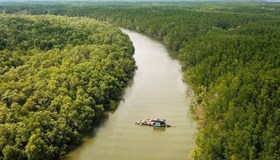
The credits will be spent on the implementation of policies to improve integrated coastal zone planning and management, public investments benefiting climate change and green growth, water resource protection and greater water use efficiency and coastal forest plantation.They will also be used to support policies in transportation, industrial production, energy saving and renewables that mitigate greenhouse gas emissions.
At Conference on Climate Change in Paris in 2015 which was organized by the Framework Convention on Climate Change of the United Nations, Vietnam committed to reduce 8% of greenhouse gas emissions compared with conventional development scenario in 2030. Moreover, Vietnam can reduce up to 25% of GHG emissions in case of receiving international support from bilateral and multilaterally cooperation. According to financial forecast, Vietnam can only allocate $ 3.2 billion to complete the reduction target of 25% of GHG emissions, the rest (17.8 billion dollars) must be supported from other countries. These political actions are activities to help Vietnam prepare to implement those commitments promised at Conference on Climate Change in Paris in 2015.
Summarized by CPSI office




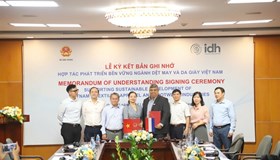 MoU on sustainable development for textiles and footwear signed
 Vietnam - UK cooperate for sustainable development
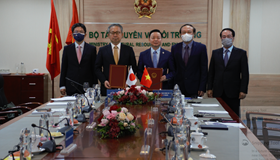 Vietnam, Japan sign a Memorandum of Understanding on low-carbon growth
 Increasing solutions in response to climate change
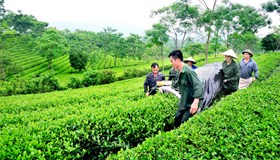 Realizing vision towards sustainable green agriculture development
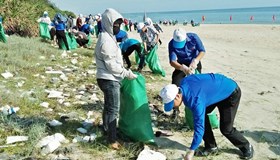 WWF-Vietnam calls to reduce plastic waste
 Promoting ASEAN cooperation towards sustainable development of mineral exploitation
 Developing forests in coastal areas in response to climate change