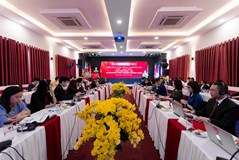
At the end of 2015, Hanoi’s economy welcomed the inauguration of the country’s largest technology transfer and assessment centre at the Hoa Lac High-tech Park located in Thach That district. Covering 2.1 hectares, the VND600 billion (US$26.4 million) facility is responsible for technological research, manufacture, appraisal and analysis in a wide range of fields including mechanical engineering, electronics and automation, energy-saving and environmental technologies, among others. With well-equipped infrastructure and the gathering of many scientists from domestic and foreign universities, research institutes and laboratories, the Hanoi Technology Research, Transfer and Assessment Centre will help stimulate the application of science and technology in all aspects of life, support industrial parks and offer advice on optimising production assemblies. The centre has succeeded in producing mechanical equipment, electronic boards, LED chips, solar panels and so on to help increase the rate of domestic content.
The Hanoi Technology Research, Transfer and Assessment is one of more than 70 projects being implemented at the Hoa Lac High-tech Park, which, under an approved plan, will cover nearly 1,600 hectares and host the research, development and the application of advanced technologies. It is also an incubator for high-tech enterprises where they can train human resources, and produce and trade high-tech products. At Hoa Lac, numerous projects have come into operation such as the Viettel High-tech Centre, FPT Company, Nissan Techno’s automotive technical centre and a medical equipment project of the Vietnam-Korea Medical Joint Venture Company. The park has so far received a total investment of nearly VND60 trillion (US$2.64 billion) and is hosting abound 10,000 staff and students.
In addition to Hoa Lac, Hanoi also has other industrial and high-tech parks such as the South Hanoi Supporting Industries Park, Quang Minh Industrial Park, Soc Son Clean Industrial Park, Hanoi Software Park and so on. These parks are producing about 40% of Hanoi’s industrial value and contributing 45% of the capital’s export revenues.
Elsewhere across the city, many enterprises are also focusing on the application of advanced and clean technologies in their management and production activities, thanks to which, Hanoi’s industry has seen significant growth. So far 60 products by 49 Hanoi enterprises have been recognised as key industrial products, most of which involve advanced technology in some phase of manufacturing. Hanoi Plastics Company, for instance, has used specialised design software to manufacture plastic moulds for Honda, Toyota, VMEP, LG in Vietnam and export their products for foreign companies such as Tostem, Hitachi and Shoden. Kova Paint has also employed nanotechnology to produce premium paints. Meanwhile Dong Anh Electrical Equipment Corporation was successful in manufacturing 500kV transformer, making Vietnam the first Southeast Asian country to do so.
Despite many efforts in recent years, the knowledge economy in Hanoi has not met expectations and potential. As such, the resolution of Hanoi’s 16th Party Congress identifies promoting the knowledge economy, and renewing the growth model in line with economic restructuring as a top priority on its economic agenda during the 2016-2020 period. In order to successfully implement these tasks, the city will focus resources on large advanced and clean technology projects. Hanoi is planning to set aside 8,000 hectares to develop clean industrial and high-tech parks. The southern districts of Thuong Tin and Phu Xuyen are planned to become biological research centres for high-tech agricultural production and processing. Meanwhile the electronic, IT, mechanical engineering, automobile, chemical and new material industries will be concentrated in northern districts. And Hanoi’s western area will focus on precise mechanics, nanotechnology, new energy and building material technologies.
Vice Chairman of the Hanoi People’s Committee Nguyen Ngoc Tuan said the city would continue to accelerate site clearance, infrastructure building at industrial parks, support enterprises in terms of administrative procedures and loans, and regularly hold dialogues with enterprises to address their difficulties. The city will increase investment in research centres, technology incubators, and train human resources. In the next five years, the capital city aims to become the nation’s leading centre for technology transfer and application, promote economic growth in tandem with science and technology, and create high-quality products so as to enhance its competitiveness.




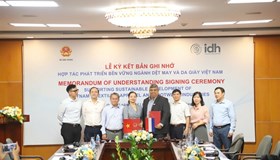 MoU on sustainable development for textiles and footwear signed
 Vietnam - UK cooperate for sustainable development
 Vietnam, Japan sign a Memorandum of Understanding on low-carbon growth
 Increasing solutions in response to climate change
 Realizing vision towards sustainable green agriculture development
 WWF-Vietnam calls to reduce plastic waste
 Promoting ASEAN cooperation towards sustainable development of mineral exploitation
 Developing forests in coastal areas in response to climate change