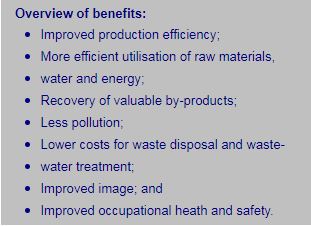
The most convincing benefit of cleaner production is its ability to reduce the consumption of resource and materials.
Savings in energy and materials bring direct reductions in production costs, which again makes the company more competitive.
With the increasing cost of raw materials, energy and water, no company can afford to lose these resources in the form of waste.
Increasing consumer awareness of environmental issues has led to a spurt in demand
of green products in the international market. Consequently, if you put in conscious efforts towards cleaner production, you open up new market opportunities and produce better quality products, saleable at a higher price.
Better access to finances
Investment proposals based on cleaner production contain detailed information on the economic, technical and environmental feasibility of the planned investment. This gives a very solid basis for achieving financial support from banks or environmental funds.
On the international market, financial institutions are awakening to the problems of environmental degradation, and are now scrutinising applications for loans from an environmental angle.
ISO 14000
Cleaner production will make it much easier to implement an environmental management system such as ISO 14000. This is because most of the initial work already has been carried out through the cleaner production assessment. An ISO 14000 certificate can be a market opener, giving better access to export markets.
Better working environment
Apart from improving the economical and environmental performance, cleaner production can also improve the occupational health and safety conditions for the employees.
Favourable working conditions can boost the morale of staff and at the same time foster a concern for controlling waste. Such actions will help your company gain a competitive edge.
Better compliance with environmental regulations
Meeting the regulatory standards for discharge of wastes (liquid, solid or gaseous) requires often installation of expensive and complex pollution control systems like wastewater treatment plants.
With cleaner production the treatment of residual effluents normally becomes easier and cheaper. This is because cleaner production leads to an all round reduction in wastes: volume-wise; load-wise; and even toxicity-wise!
Cleaner Production Assessment
To be able to identify cleaner production options, it is necessary to carry out a cleaner production assessment.
The cleaner production assessment focuses on:
- WHERE waste and emissions are generated;
- WHY waste and emissions are generated; and
- HOW waste and emissions can be minimised in your company.
Cleaner production assessment is a useful tool to systematically investigate the existing production and to identify opportunities for improving the production or the products.
Step 1: Getting Started
- Ensure top management commitment;
- Form a cleaner production team;
- List process steps and identify waste streams;
- Prepare process flow charts; and
- Select focus areas.
Step 2: Analysing Process Steps
- Make material and energy balances;
- Characterise waste streams;
- Assign costs to waste streams; and
- Identify causes of waste generation.
Step 3: Generating Cleaner Production Options
- Generate workable cleaner production options; and
- Sort options into: "directly implementable"; "needs further study"; and "rejected options".
Step 4: Selecting Cleaner Production Options
- Analyse technical feasibility of cleaner production options;
- Analyse economic viability of cleaner production options;
- Analyse environmental feasibility of cleaner production options; and
- Select cleaner production options for implementation.
Step 5: Implementing CP Options
- Make a cleaner production action plan;
- Implement the cleaner production options.
Step 6: Maintaining Cleaner Production
- Monitor and evaluate results;
- Report cleaner production results;
- Prepare for a new cleaner production assessment; and
- Continuously integrate cleaner production activities into daily management.
Barriers to Cleaner Production
Myths about cleaner production
There are many myths about cleaner production. All these are wrong:
- Cleaner production is only good for large companies;
- Cleaner production requires big investments;
- Cleaner production requires modern technology; and
- Cleaner production has a limited potential.
Mental blocks against cleaner production
Cleaner production will improve your company. However, improvements require changes - and there are many mental blocks against changes:
- Fear of being seen as a fool;
- Fear of disturbing tradition;
- Fear of being alone;
- Fear of being criticised;
- Fear of being misused; and
- Fear of making mistakes.
Proven and effective idea killers
Do not accept the following answers:
- Lets think about it later;
- We have already tried it;
- It is not the right time;
- You do not understand the problem;
- Talk to John this is not my field;
- It sounds nice in theory, but it will not work in practice;
- We are too small/big for it;
- It will not work with our production; and
- It does not fit into our planning.




 MoU on sustainable development for textiles and footwear signed
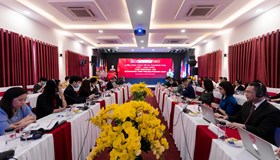 Vietnam - UK cooperate for sustainable development
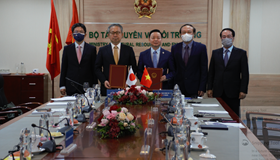 Vietnam, Japan sign a Memorandum of Understanding on low-carbon growth
 Increasing solutions in response to climate change
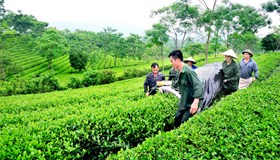 Realizing vision towards sustainable green agriculture development
 WWF-Vietnam calls to reduce plastic waste
 Promoting ASEAN cooperation towards sustainable development of mineral exploitation
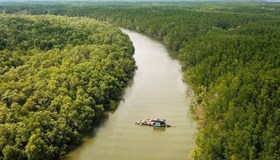 Developing forests in coastal areas in response to climate change