The Gia Sang Steel Making and Rolling Joint Stock Company was established in 1975 with the original capacity of 60,000 tonnes per year. The company's main product is construction steel.
Before taking part in the Cleaner Production Component in Industry (the Component for Cleaner Production in Industry is a part of the Program of Development Cooperation in the Environment between the governments of Vietnam and Denmark for 2005-2010), the company faced a lot of difficulties with regard to the environment such as eliminating waste gas, dust, waste water and solid wastes…. In addition, producing steel consumed a large amount of energy. This does serious harms to the working environment and surrounding environment and contributes to raising production costs.
To deal with those difficulties, in 2009, under the assistance of the Cleaner Production Component in Industry under the Ministry of Industry and Trade, the company took part in the component and applied cleaner production methods.
In the first stage (from January to September 2009), the company established a 14 member team which was responsible for assessing the results of cleaner production methods. After that, many methods at low cost or did not costs any money were applied. For example, before taking part in the Cleaner Production Component, the company wasted a large amount of input materials. To produce one tonne of product, the company had to use 1,200kg of scrap steel due to backward scrap steel processing technology. In addition, the company consumed a large amount of energy. To produce on tonne of steel, 817-838kWh of electricity and 54kg of Fuel Oil (FO) were used because input materials have low quality, furnace cover is not tight and charging materials time is lengthened. In the casting workshop, casting stage is done manually, thus this stage consumed a great deal of materials. Moreover, the temperature in the workshop is rather high, doing negative influences on worker's health and their working capacity. To deal with those weaknesses, the cleaner production team applied methods to reduce input materials such as using high quality scrap steel, regularly cleaning scrap steel stores, classifying scrap steel, installing five tonne hoist to load and unload materials and preserving the amount of scrap steel which is used for one month… Apart from saving energy, the company applied methods to avoid losing materials and raising product quality such as repairing leaking points, especially junction points which use washers and improving cooling system. In addition, to reduce energy consumption, the company produced and used electrical cooling device, used tight furnace cover, cleaned the heat exchange pump each three months, installed four electricity meters for four refining furnaces to watch electricity consumption and replaced incandescent lamps with 50W compact lamps. When the first stage of cleaner production component finished, with just VND654 million, the company saved VND5.8 million in production. In addition, 25 percent of solid wastes and 14 percent of waste gas were reduced.
After finishing the first stage, in the second quarter of 2010, the company made a survey to apply next steps of the second stage. Specifically, the company applied synchronized methods such as improving vacuum cleaner, increasing the furnace capacity and replacing siphon casting technology with monolithic technology. Those methods cost VND31.1 billion. It is estimated that in 2011, the company's capacity will be raised to 80,000 tonnes and steel quality will be improved. Particularly, 960 tonnes of exhaust fumes will be reduced annually and the environmental standards will be guaranteed./.
By Viet Nga & Bao Ngoc




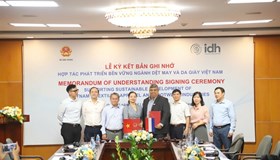 MoU on sustainable development for textiles and footwear signed
 Vietnam - UK cooperate for sustainable development
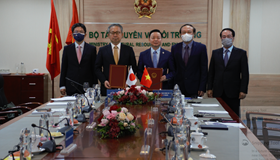 Vietnam, Japan sign a Memorandum of Understanding on low-carbon growth
 Increasing solutions in response to climate change
 Realizing vision towards sustainable green agriculture development
 WWF-Vietnam calls to reduce plastic waste
 Promoting ASEAN cooperation towards sustainable development of mineral exploitation
 Developing forests in coastal areas in response to climate change