The Tia Sang Battery Joint Stock Company is one of the three members of
the Vietnam National Chemical Group, which specialize in producing and
trading in lead-acid batteries. The company currently produces 120 types
of batteries for use to start up automobiles, motorcycles, information
and communication facilities, and electrical stations. Its products are
not only sold in Vietnam but also exported to many other countries such
as Sweden, the UK, Czech Republic and the Republic of Korea.
Engineer
Hoa Quang Nam, the chairman of the board and general director of the
company, said, "As one of successful examples in Hai Phong in the field
of cleaner production in industry, in the production process, the Tia
Sang Battery Joint Stock Company pays primary attention to saving
materials, electricity and water as well as waste water and waste
treatment." Battery production requires very much clean water, minerals
and overheated steam. Therefore, the company gives top priority to
applying methods which allow it to use less power and electricity so as
to reduce the production cost. Specifically, to reduce power
consumption, the company has invested more than VND52 billion in
equipment innovation. Specifically, it has replaced the old grinding
equipment that was imported in 1999 with new equipment, which allows the
company to save 420,840kWh of electricity and 7,560cu.m of water; the
company is using Enerkeeper EKS 33-700KVA, a power saving device that
allows it to save nine percent of power consumption; the 0.13-0.45-kWh
fan system has been replaced with the 0.75-1.1-kWh fan system, and
high-pressure lamps replaced with compact lamps.
Previously, to
create distilled water for making up sulfuric acid (H2SO4) and steam,
the company had to use about 700-750 tonnes of coal each year, and when
coal was burnt, large amounts of waste gas emissions occurred, causing
the greenhouse effect. To improve the situation, the company has
replaced the two coal burning furnaces with an ion exchange system that
runs with Reverse Osmosis (RO) technology. This solution allows the
company to reduce coal consumption to 38 tonnes per year and water
consumption by 400cu.m per day. Compared with 2001, coal consumption has
been reduced by 85 percent, electricity by more than 40 percent, and
water by 78 percent.
The company pays much attention to waste
treatment. It uses Ca(OH)2 and CaCO3 to treat wastewater that contains
H2SO4 and PbSO4. Wastewater that contains lead dust is treated for reuse
purposes. Wastewater of other kinds is treated with biotechnology
before being discharged.
Waste gas containing lead dust is also
thoroughly treated before coming out to the environment. NaOH is used to
treat waste gas that contains acid gas. Currently, the company ensures
that 100 percent of wastewater and 95 percent of waste gas occurring
during the production process is treated. Every day, about 110cu.m of
wastewater is treated for reuse purposes. About 95 percent of dangerous
and normal solid waste is collected and treated, and about 70 percent of
solid waste is recycled for reuse purposes.
Along with
technological and equipment innovation, the company pays much attention
to improving workers' awareness in the field of environmental
protection. Regulations on occupational safety, fire prevention and
environmental protection have been disseminated to all workers. The
company applies a policy that offers a bonus to workers who seriously
abide by environmental protection regulations. In 2007, the company was
presented a diploma of merit for its achievements in the field of
environmental protection. In 2008, it received a Gold Cup for
Environmental Protection from the Ministry of Natural Resources and
Environment. Notably, with a project aiming to apply cleaner production
methods, the company received the Second Prize at the 2009 VIFOTEC
(Vietnam Fund for Technical Creativeness) contest./.
By Phuong Lan




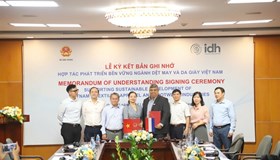 MoU on sustainable development for textiles and footwear signed
 Vietnam - UK cooperate for sustainable development
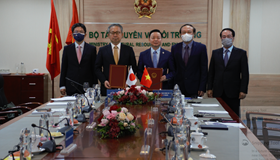 Vietnam, Japan sign a Memorandum of Understanding on low-carbon growth
 Increasing solutions in response to climate change
 Realizing vision towards sustainable green agriculture development
 WWF-Vietnam calls to reduce plastic waste
 Promoting ASEAN cooperation towards sustainable development of mineral exploitation
 Developing forests in coastal areas in response to climate change