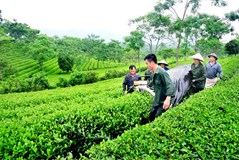
Starting production in 2005, the Ngoc Lap Tea Factory processes 1,000 tonnes of dried tea per year for sale inside and outside Vietnam.
Before the factory joined the Cleaner Production in Industry (CPI) program, it encountered major problems caused by dust, noise and gas emissions that directly affected the working and living environment in and around the factory. The factory used to emit about 2,500 tonnes of carbon dioxide (CO2) per year.
Having acknowledged cleaner production importance and wishing to solve environmental pollution problems, in 2007 the factory began implementing cleaner production solutions with assistance from the Ministry of Industry and Trade and the Vietnam Cleaner Production Center.
From May to October 2007, the factory was establishing a cleaner production team to assess cleaner production in the whole factory. After that numerous low-cost solutions were thoroughly implemented at the factory. Before Ngoc Lap joined the CPI program, its tea loss rate was high, about 82 tonnes of fresh tea per year, due to the substandard bed of the workspaces and adequate raw material supplying systems. Besides, electric power and coal consumption was high at the factory.
To fix the problems, the factory's cleaner production team kicked off a number of solutions to decrease raw material losses. They included improvement of worker's awareness of making production more efficient, repairing the bed of the workspaces, fixing the oil leaking problem, covering the open transmission system to improve product hygiene, and more.
The factory also realized solutions to reduce electric power consumption, including replacing neon lights with compact lamps, issuing concrete industrial processes for specific machines, and more.
Ngoc Lap assigned its workers to control coal quality while improving the furnace burning technique and applying thermal isolation to covers of heat-conducting equipment. Costing a total of VND28.5 million, these solutions made the factory save VND486 million and reduce dust emissions by 30 tonnes and carbon dioxide emissions by 275 tonnes per annum one year after they were realized.
When Ngoc Lap entered the CPI program's second phase in 2008 the factory began major investment solutions, including the installation of a dust filtering system and a clean air provision network and upgrading the heat provision system of warehouses and workspaces, that all helped considerably reduce dust emissions and raw fuel losses.
The total cost of these two solution groups is VND2.203 billion. After one year the factory saved VND403 million while decreasing dust emissions by 50 tonnes and carbon dioxide emissions by 550 tonnes per year. The bigger benefit is the cleaner environment that the factory has reached through applying cleaner production solutions.
Having seen the great benefits that cleaner production has brought in for it, the Ngoc Lap Tea Factory decided to continue cleaner production solutions after the CPI program ended in 2008. Specifically, the factory will continue implementing cleaner production solutions including thermal isolation for hot air transmission systems, water consumption management, fermentation area isolation and more to improve product quality and the working environment./.




 MoU on sustainable development for textiles and footwear signed
 Vietnam - UK cooperate for sustainable development
 Vietnam, Japan sign a Memorandum of Understanding on low-carbon growth
 Increasing solutions in response to climate change
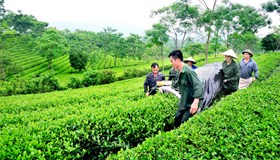 Realizing vision towards sustainable green agriculture development
 WWF-Vietnam calls to reduce plastic waste
 Promoting ASEAN cooperation towards sustainable development of mineral exploitation
 Developing forests in coastal areas in response to climate change