Cleaner production is becoming a common trend among businesses, helping them save financial resources through efforts to minimize energy, material and fuel wastage, thus improving the efficiency of their operations as well as the quality of products while maintaining the stability in production. Cleaner production also helps businesses recover waste materials and ameliorate the working environment, improving the image of businesses and helping reduce costs. However, to apply cleaner production methods, businesses have to spend large amounts of money on technological innovation – this is the biggest obstacle to cleaner production.
The GCTF was established under an initiative of the Swiss State Secretariat of Economic Affairs (SECO) to provide financial assistance for developing countries in order to promote medium and long-term investment in cleaner production in industry and services. In Vietnam, the fund provides financial assistance for small and medium-sized enterprises (SMEs) as these businesses often have to cope with difficulties such as capital shortages and difficulties in accessing bank loans due to the lack of collateral when they need capital to invest in equipment or technological innovation. The Vietnam Cleaner Production Center (VNCPC) is responsible for coordinating capital resources of the GCTF.
Nguyen Le Hang, a GCTF coordinator, said that the fund operates in association with the Asia Commercial Bank (ACB), the Vietnam Technological and Commercial Joint Stock Bank (Techcombank) and the Vietnam International Commercial Joint Stock Bank (VIB) to assess technological innovation projects of businesses and decide suitable levels of financial support for them. If their projects meet VNCPC-set criteria in terms of minimizing environmental impacts, businesses will receive financial assistance from the GCTF. The fund will provide financial assistance in the form of security for a maximum 50 percent of the total value of the loans and a bonus worth 15-25 percent of the total value of the loans. For example, if a business wants to borrow VND1 billion to invest in a technological innovation project and meets VNCPC’s criteria, the GCTF will stand security for the business to borrow VND500 million and offer it a VND250 million bonus when the project is completed and comes into operation.
The time required to consider a project is 75 days. The GCTF’s financial assistance will reach businesses operating in the fields of industrial production, services and trade, which want to change production modes and improve equipment to minimize environmental impacts. A priority will be given to businesses operating in sectors such as construction materials, paper, food processing, steel, metallurgy, leather and chemicals. “Businesses with chartered capital of less than US$5 million with domestic investment capital accounting for 51 percent and less than 1,000 employees can seek access to financial assistance from the fund,” said Nguyen Le Hang.
So far, 60 businesses in Vietnam have sent applications for the GCTF’s financial support. Of these, 30 businesses have had their projects technically approved and 12 projects have been provided with bank loans.
Nguyen Le Hang added that the credit assistance for each project currently ranged from US$10,000 to US$1 million. However, banks can provide businesses with bigger credit loans and give a priority to environmentally friendly projects./.




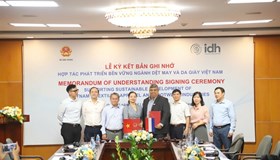 MoU on sustainable development for textiles and footwear signed
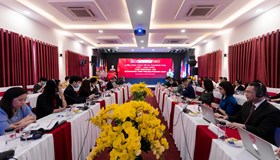 Vietnam - UK cooperate for sustainable development
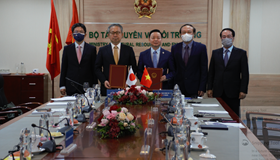 Vietnam, Japan sign a Memorandum of Understanding on low-carbon growth
 Increasing solutions in response to climate change
 Realizing vision towards sustainable green agriculture development
 WWF-Vietnam calls to reduce plastic waste
 Promoting ASEAN cooperation towards sustainable development of mineral exploitation
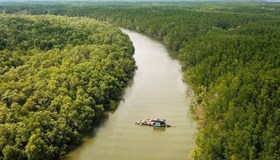 Developing forests in coastal areas in response to climate change