In the company's exhaust gas, the percentage of CO (carbon monoxide) is 10.5 times more than the permitted level, SO2 (sulfur dioxide) 1.15 times, NH3 (ammonia) 1.33 times and dust 1.3 times. With the purpose of reducing environmental pollution, since 2007, the company has participated in the Component of Cleaner Production in industry (CPI) (the Component of CPI is part of the Viet Nam-Denmark Development Co-operation in Environment program under the Ministry of Industry and Trade chairmanship). Nguyen Van Do, the Deputy Chairman of the company said: "In order to gain best production results, production activities are divided into two stages which have been carried out under supervision of 14 staff in the company's cleaner production unit."
The company started the first stage with activities which require little expense, focusing on reducing electricity and coal consumption and dust elimination. In detail, this included reducing electricity use, and engines have been rearranged to suit additional charges. Saving electricity devices have been installed. Signal lights have been replaced with low capacity lights. 50W compact fluorescent light bulbs have been used. The total cost of the upgrading amounted to VND970 million which helps the company save VND740 million per year.
To lessen dust elimination, a dust filter system has been regularly maintained and cleaned. The company grows trees around production zones. Thanks to this, each year, the company saves VND30 million and reduces 200 tonnes of dust elimination.
Before participating in the Component for CPI, the company wasted a large amount of coal due to a lack of adequate storage. In addition, backward furnaces contributed to large coal consumption. To overcome this difficulty, the company has improved the furnace system with heat isolation system. Coal is stored on rainy days. Thanks to these methods, which were costed at VND100 million, the company has reduced coal usage by 140 tonnes and saved VND76 million per year.
The first stage has successfully been finished. The company started the second stage with more expensive methods. Before participating in the component, the company had to face a backward material supply system which caused difficulties to control material amount and percentage use. The clinker jaw crusher has low capacity, and was having a negative influence on productivity and equipment longevity. The company has installed two bunkers to contain clinker before falling to the crushers. In addition, the company has improved other equipment during the production process. Total money invested stood VND1.063 billion. A year later and the company has earned VND466 million from a 10 percent productivity increase, saved three percent of electricity and reduced by 90 percent of dust emission equally to 259 tonnes of CO2 (carbon dioxide) per year.
Another method in this stage is investment in packaging technology. Before, out-of-dated technology for product packaging lessened capacity and wasted a big amount of cement. To solve this problem, a BHYW packaging machine has been purchased. A 20,000cu.m dust filter has been installed to absorb cement eliminated during packaging stage. These method cost more than VND1.9 billion but they have helped the company earn VND534 million, reduce electricity to 0.135kWh per tonne of cement and decrease 200 tonnes of dust, 195 tonnes of CO2 (carbon dioxide) per year.
In particular, to avoid coal waste, a 700 tonne coal storage depot has been built, which can meet coal demands for two months. This method was capitalized at VND2.2 billion. Every year, the company saves VND800 million from coal and electricity conservation, reduce 77 tonnes of dust and 850 tonnes of CO2 (carbon dioxide).
"The second stage ended in 2008. Following the encouraging results of cleaner production, the company decided to lengthen the operation of cleaner production unit and every six months, the company does an environmental impact assessment to maintain economic and environmental achievements while participating in cleaner production." Do said./.




 MoU on sustainable development for textiles and footwear signed
 Vietnam - UK cooperate for sustainable development
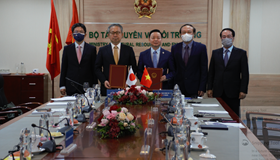 Vietnam, Japan sign a Memorandum of Understanding on low-carbon growth
 Increasing solutions in response to climate change
 Realizing vision towards sustainable green agriculture development
 WWF-Vietnam calls to reduce plastic waste
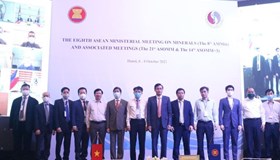 Promoting ASEAN cooperation towards sustainable development of mineral exploitation
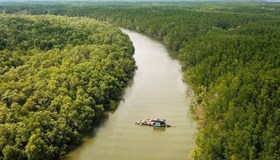 Developing forests in coastal areas in response to climate change