Energy audit result of Binh Son Refinery and Petrochemical JSC
Thứ tư, 31/07/2019
Binh Son Refinery and Petrochemical JSC (BSR), which is under the Vietnam Oil and Gas Group (PetroVietnam), operates Dung Quat oil refinery and lays the foundation for the development of petrochemical industry in Vietnam.
Binh Son Refinery and Petrochemical JSC (BSR), which is under the Vietnam Oil and Gas Group (PetroVietnam), operates Dung Quat oil refinery and lays the foundation for the development of petrochemical industry in Vietnam.
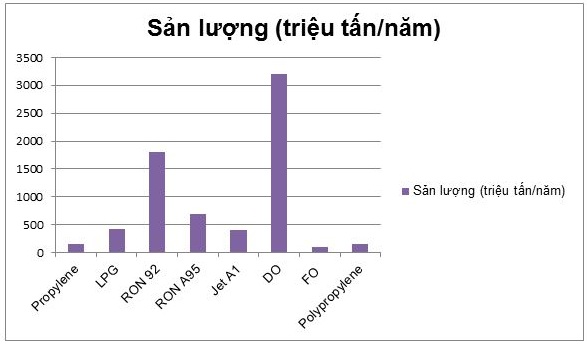
Binh Son Refinery and Petrochemical JSC (BSR), which is under the Vietnam Oil and Gas Group (PetroVietnam), operates Dung Quat oil refinery and lays the foundation for the development of petrochemical industry in Vietnam. Its main products are LPG, propylene, polypropylene, jet fuel/JA1, kerosen, A92/A95 gasoline, FO.
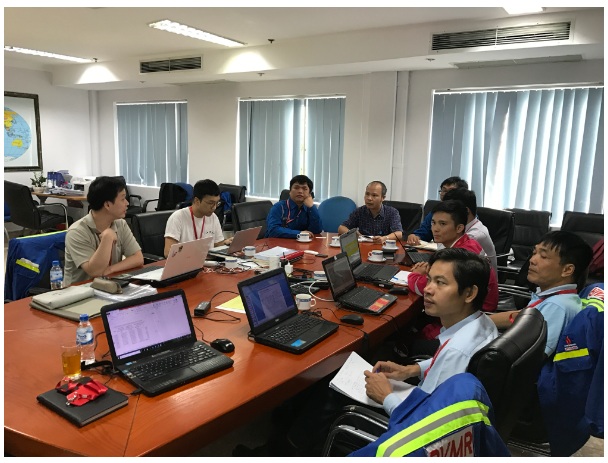
Energy experts in BSR
Production situation
With a processing capacity of 6.5 million tons of crude oil (148,000 barrels/day), BSR produces annually 6.2 million tons of products and meets about 30-40% of the gasoline demand of Vietnam.
Energy efficiency potential
Energy audit results show huge energy efficiency potential of BSR. Carrying out proposed energy efficiency solutions whose expected investment cost is about US$78.2 million, BSR will achieve fuel savings of 27.3 Gcal/h và electricity savings of 22.5 MW, equivalent to US$51.4 million.
Particular energy efficiency solutions
25 energy solutions are found during energy audit period including hot separator application, heat recovery solutions, PRT application.
| Solution No. 1: Install a new Hot Separator – NHT | |
Real situation The hydrocarbon product, after exiting the reactor, has a temperature of about 329oC. It is then subject to heat recovery together with the input materials at E-1201A-H and cooled by air at E-1202A/B (whose capacity is about 5 mmkcal/hour) to 48oC. Then it moves to D-1203 separator. | Expected output Consider installing hot separator after the hydrocarbon product exits from the reactor and is subject to heat recovery by E-1201A-H into liquid flow and gas flow. The gas flow is further cooled by the E1202A/B heat exchanger and then separated at a low temperature by D1203. The liquid flow will combine with the liquid flow from D1203 and continue to be heated before entering T1201 tower. |
| Energy efficiency results | |
| Fuel savings: 0.96 Gcal/h | Investment cost: USD 770,000 |
| Cost savings: USD 859,000/year | Payback period: 0.9 year |
| Solution No.2: Raise the temperature of the Debutanizer material from the product line of reactive equipment R-1301/2/3/4 | |
Real situation The hydrocarbon product from R-1301/2/3/4 reactor having the temperature of 495oC is subject to heat exchange with the input material flow at E-1301/1302. Its temperature drops to 114oC. Then it continues to be cooled by E-1303A-H (whose capacity is about 12.11 mmkcal / hour) to 43oC, before entering D-1301 separator. | Expected output Consider installing an additional heat exchangers taking advantage of the heat of the hydrocarbon product from R-1301/2/3/4 reactor after it is subject to heat exchange with E-1301/02 to heat the Debutanizer material, instead of the high temperature flow from the bottom of Debutanizer tower. The high temperature flow from the Debutanizer bottom will be used to heat the Ligh-Heavy Naphtha Slipter / T-1202 bottom, instead of using MPS medium pressure steam. |
| Energy efficiency results | |
| Energy savings: 1,129 toe/year | Investment cost: USD 1.155 million |
| Cost savings: USD 650,000 | Payback period: 1.78 years |
| Solution No.3: Improve the efficiency of the insulation / coating system inside the CDU | |
Real situation Currently, crude oil-fired heating furnace (H-1101) is insulated with refractory bricks, to minimize heat loss to the environment. | Expected output Consider applying the "High emissivity coating" to the CDU to increase its thermal radiation coefficient, ability to absorb heat and reduce heat loss to the outside, leading to increasing thermal efficiency from 1-3%. Each 1% increase in thermal efficiency will reduce fuel consumption by about 0.9 mmkcal/hour |
| Energy efficiency results | |
| Fuel savings: 0.9 Gcal/h | Investment cost: USD 0.619 million |
| Cost savings: USD1.9 million | Payback period: 1.9 years |
Binh Son Refinery and Petrochemical JSC (BSR)is one of 10 enterprises entitled to energy audit implementation within the framework of the Project for Promoting Investment Market for Energy Efficiency in Industrial Sector in Vietnam, funded by the Korean Government through Korean International Cooperation Agency (KOICA). PetroVietnam Maintenance and Repair Corporation (PVMR) cooperated with Korean energy experts in conducting energy audit at BSR in December 2018 |
Tung Vuong